
A well-produced interview video can sometimes have more impact than an expensive promotional film because it feels more direct and genuine. That is what makes interview videos so valuable in a communication strategy.
At first glance, an interview video may seem simple to produce. However, achieving a natural and professional result still requires a minimum amount of preparation. Here are some tips to help you prepare and successfully create your corporate interview video.
Why use interview videos in business communication?
Before starting the shoot, the first question to ask is simple: why are you making this interview?
It is important to define a clear objective beforehand because an interview video will not be built the same way depending on whether it is intended for internal or external communication, recruitment purposes, customer reassurance, showcasing expertise, or highlighting company culture.
A recruitment interview video will often aim to show the working atmosphere, personalities, and human values within the company. A client interview will focus more on trust and feedback. A company leader’s interview may, for example, be used to explain a project, a company evolution, or the company’s direction.
Before getting started, it is therefore essential to think carefully about the message you want to convey.

How to create an authentic interview video?
Viewers generally appreciate videos that feel more spontaneous and easier to follow. To achieve this, choosing the right speaker is important. People often automatically think of the company director or the highest-ranking person in the business. However, this is not always the best choice. Some people may have strong expertise but may not feel comfortable on camera. On the other hand, a more spontaneous employee can sometimes communicate much more emotion and credibility.
In an interview video, an overly prepared speech is usually noticeable very quickly on screen. A fully memorized script can also feel unnatural. Preparing the main ideas is useful, but writing every sentence in advance can quickly make the exchange feel less natural on camera.
To avoid this, it is often better to prepare themes, bullet points, and key ideas rather than a fully written script. Leaving a little room for improvisation often helps produce more natural answers.
The choice of questions is also important. Closed-ended questions usually lead to short and less engaging answers. Open-ended questions, on the other hand, often encourage more personal and meaningful responses.
For example, instead of asking “Were you satisfied with the project?”, it is often more interesting to ask “What stood out to you during this project?” or “Why was this project important to you?”.
Preparation still remains essential. Even if an interview should feel natural, it should not be entirely improvised. It is important to think about the topics to cover, the main messages to communicate, and the order of the questions.
Even in a simple format, there is usually a sense of progression. The interview often starts with some context, then develops a topic or experience before ending with a conclusion or an opening statement.
How to improve the quality of an interview video?
The technical side also deserves attention. Not every interview requires the same equipment or budget. You do not need a huge cinema-style production setup or a large advertising shoot to film a good interview video, but some details can strongly influence the final result.
Sound, for example, is often underestimated. However, viewers will generally tolerate imperfect visuals more easily than poor audio quality. Good sound immediately improves the perceived quality of a video.
Lighting also plays an important role. Harsh lighting, strong backlighting, poorly exposed faces, or an unappealing background can quickly create an amateur look, even when using an excellent camera.
When it comes to the setting, the goal is not simply to find a “nice-looking” location. The place should say something about the company or the person being interviewed. Filming an interview in a relevant environment immediately gives the content more credibility.
For example, a craftsman can be filmed in their workshop, a restaurant owner in their kitchen or dining area, or an industrial company in its facilities or production areas.
Framing also influences the viewer’s perception. A shot that feels too static or too tight can make the video feel cold. On the other hand, a more dynamic composition with some depth and a carefully arranged background gives the video more personality.
In addition, using two cameras helps make the interview more dynamic.
How to make the speaker feel comfortable?
It is also important to make the speaker feel comfortable. This is probably one of the most underestimated aspects of filming an interview. Some people are simply not used to speaking in front of a camera. As soon as filming begins, stress can quickly make their answers feel more rigid.
The director or interviewer directly influences the quality of the conversation. A successful interview video often depends on the quality of the interaction off camera. The more comfortable the speaker feels, the more they gradually forget about the technical setup.
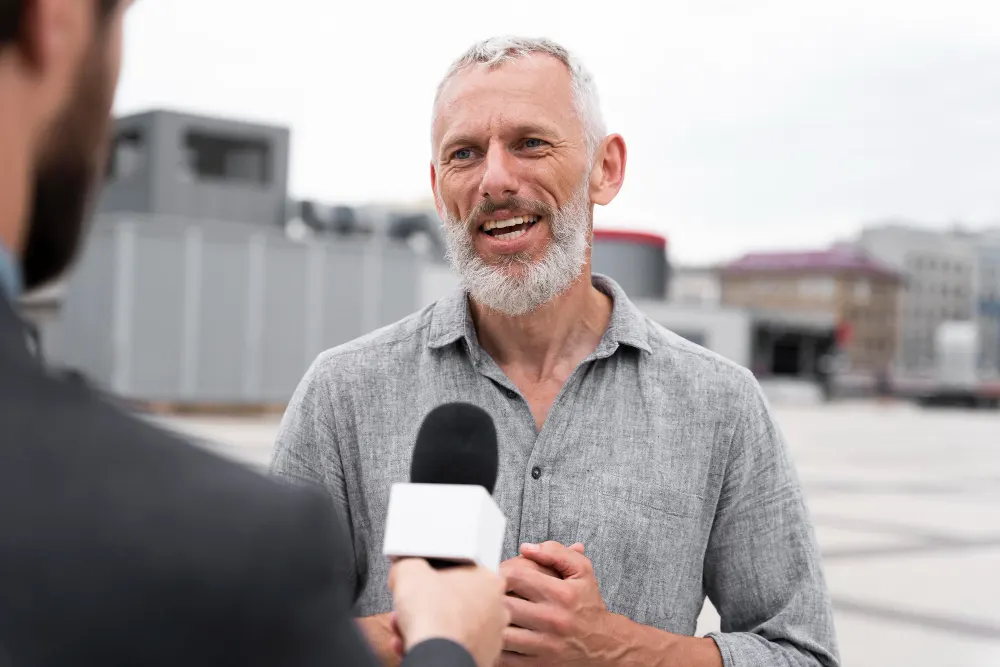
Sometimes, it comes down to very simple things: talking before filming starts, avoiding turning the camera on immediately, asking questions in a natural way, and accepting hesitations or mistakes.
Editing
Editing strongly influences the pacing and final result of the interview. Even a good discussion can lose interest if the rhythm feels too slow or if certain sections are kept for too long. Editing helps make the video more enjoyable to watch.
The goal is not to cut every pause to create an artificial rhythm, but to keep what matters most. Repetitions, lengthy sections, or less interesting parts can be removed.
When filming an interview, it is always useful to capture additional footage such as gestures, the work environment, details, interactions, machines, offices, or products. These shots help illustrate the discussion and avoid using a static shot of the speaker throughout the entire video.
Subtitles have become almost essential, especially for social media. A large number of videos are watched without sound, particularly on mobile devices. A subtitled interview video will generally be much more effective in terms of viewer retention.
The ideal length depends on the distribution platform. On LinkedIn, a one- to two-minute interview can work very well if the message is clear and direct. On a website, a longer format may be considered, particularly to improve SEO and increase time spent on the page.
It is also possible to adapt the same interview into several formats. A longer version can be published on YouTube or on the website, followed by shorter clips for Instagram, LinkedIn, or TikTok.
An effective interview video often relies on good preparation and quality editing.
Even with a simple setup, a clear and easy-to-follow discussion can be enough to create a professional video. Are you looking for a company to film your interview? Feel free to contact us.